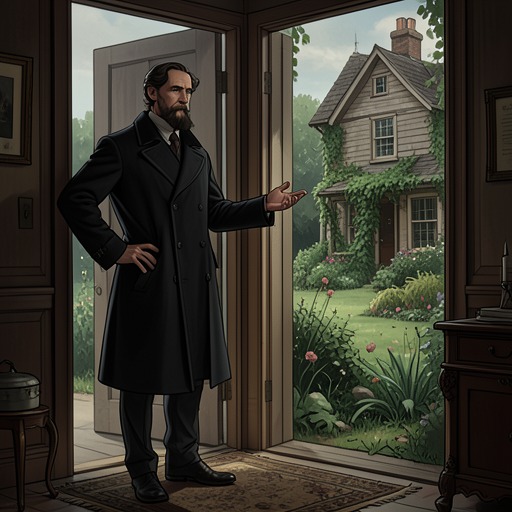
Charles’s final attempt to regain access to Blackwood House
We Have Always Lived in the CastleCharles Blackwood’s final attempt to regain access to Blackwood House brings his appeals, his interest in the family fortune, and an outsider’s camera to the sisters’ locked door. His return briefly tests whether Constance Blackwood will answer him; instead, Mary Katherine Blackwood and Constance stay inside until he leaves, then laugh together in the ruined house. The scene converts a possible reunion into a decisive confirmation that Charles can no longer enter their private world.
Arrival and the prospect of access
Charles comes back only once, arriving by car with another man late one afternoon. The strangers who had been watching the house have gone, and Constance has just stirred and said, “Time to put on the potatoes,” when the car turns into the driveway. The domestic routine gives way to another watch: Constance settles back down, while the visitors get out and walk to the foot of the steps. They look up at the house, unaware that the sisters can see them inside. Mary Katherine remembers Charles’s first visit, when he stood looking up in the same manner; the resemblance makes the difference plain. This time, she is certain, he will not get in.
The house itself presents a mixed prospect to the men outside. Charles points out that vines have grown over it and that it no longer looks as bad as it did, but he also acknowledges that the roof has burned away and the interior was gutted. The overgrowth softens the view without undoing the fire’s damage. Inside, Mary Katherine touches the front-door lock to check that it is fastened. Constance turns and nods: both sisters understand that keeping the door shut is the answer to Charles’s arrival.
A visit shaped by money and a camera
Charles has not come alone or solely to see his cousin. The other man wants to know whether the women might speak to him or come to a window so he can take a picture. Charles describes himself as their cousin and recalls that he visited before; he then asks whether he will receive half if the material is sold to a magazine or elsewhere. When the other man promises, Charles agrees to try to draw Constance out. The arrangement makes the proposed visit an attempt to turn the sisters and their house into material for sale.
Charles tells the photographer that the women have uncounted money, some buried, some in a safe, and possibly more hidden elsewhere. He presents their seclusion alongside this supposed fortune, casting the locked house as a place where wealth is concealed from view. The camera is also kept out of sight: the other man returns to the car, takes it out, and positions himself where the sisters cannot see him. Charles then climbs the steps and calls for Constance. The plan depends on appearing familiar at the door while a stranger waits to record whatever response he can produce.
The appeal at the locked door
From inside, Mary Katherine watches Constance as Charles calls to her. She thinks that Constance has never seen him so truly before, and recognizes that Constance now sees him as a ghost and a demon, one of the strangers. Charles asks them to forget what happened and be friends again. His voice is pleasant and pleading; he says he has waited for Constance to let him return and apologizes conditionally, in case he offended her. Yet he is speaking to a closed door, not to a willing participant. Mary Katherine and Constance sit on the floor on either side of it, listening while his feet remain visible on the porch and one taps repeatedly.
Charles invokes Julian Blackwood as another reason for his return, saying that he visited Julian’s grave and left flowers because Julian had been good to him. The appeal becomes more revealing when Charles tells the other man that he was the cause of everything and did not mean matters to turn out this way. He wonders aloud why two women have shut themselves in a house like this. Mary Katherine thinks Constance might answer or laugh, and touches her arm as a warning; Constance does not turn toward her. Charles’s confession does not open the door. It is followed by a request for a picture of him knocking, then by louder pleas for Constance to let him in, with the family money again invoked.
The photographer refuses to wait indefinitely. He calls the effort a waste of time, puts his camera back in the car, and says he will leave. Charles continues to plead, insists he means what he says, and starts down the steps while promising that one word could make him stay. Mary Katherine admits she is unsure whether Constance can contain herself until he has safely reached the car. The suspense rests not on whether Charles can force his way in—the door is secured—but on whether Constance will choose to answer him before he goes.
Departure and the sisters’ answer
At the foot of the steps, Charles says goodbye, looks back once, raises his hand sadly, and gets into the car after the other man urges him to hurry. His performance of regret and his final gesture produce no invitation. The car starts and drives down the driveway; only then do Constance and Mary Katherine laugh. They hold each other in the dark hall, and their laughter echoes up the ruined stairway. The sound fills the damaged house that Charles had described from outside, but it does not call him back in.
Constance gasps that she is happy, repeating her happiness to Mary Katherine. Mary Katherine answers that she had told Constance she would like it on the moon, returning to the sisters’ image of their secluded life as refuge. The ending places their shared laughter and intimacy against Charles’s failed appeal and departure. His last visit confirms not a restored family connection but the sisters’ continuing choice to remain together behind the locked door.